The National Audit Office (NAO) has released a detailed report addressing the persistent problem of long driving test waiting times across the UK. Published on 17 December, the report examines why delays continue years after the COVID-19 pandemic and assesses the response of the Driver & Vehicle Standards Agency (DVSA) and the Department for Transport (DfT).
The findings confirm what learner drivers and instructors have been experiencing for some time: access to driving tests remains difficult, and meaningful improvements will take several more years unless capacity increases significantly.
The DVSA has welcomed the NAO’s independent investigation and acknowledged the challenges highlighted in the report. The agency has openly accepted that both learner drivers and driving instructors have been affected by ongoing delays in accessing this essential public service.
The DVSA has reiterated its commitment to resolving the issue and confirmed that it will continue working closely with the Department for Transport to address the operational and structural problems identified by the NAO.
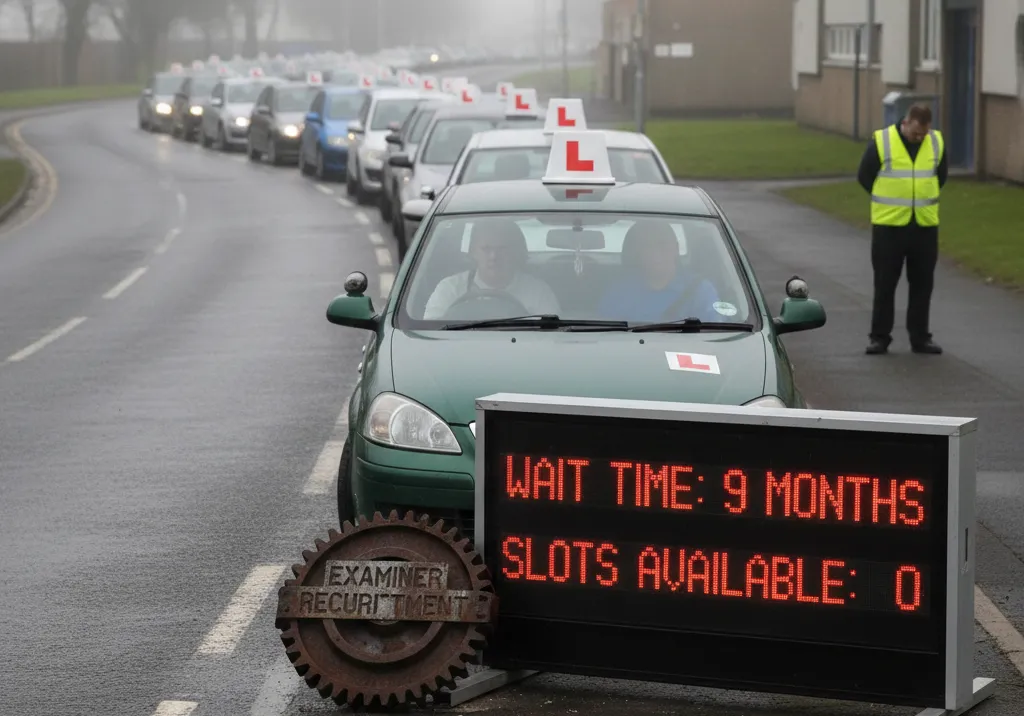
One of the major concerns raised in the report relates to how the DVSA estimates demand for driving tests and forecasts recovery timelines. According to current projections, average waiting times are not expected to return to pre-pandemic levels of seven weeks or less until November 2027.
To meet this target, the DVSA would need to significantly accelerate test availability. This would primarily require expanding the workforce by recruiting approximately 18 additional driving examiners every month on a sustained basis.
The report suggests that earlier forecasting models failed to fully identify the long-term nature of increased demand, not just the immediate backlog caused by the pandemic.
Despite the challenges, the DVSA has taken steps to increase capacity. Between June and November 2025, the agency conducted nearly 75,000 more driving tests compared to the same period in 2024.
Several measures are currently in place to support this increase, including:
These efforts are designed to stabilise the workforce and gradually improve test availability.
To further support capacity, 36 defence driving examiners from the Ministry of Defence (MOD) will assist the DVSA over the coming year. This support is expected to enable the delivery of up to 6,500 additional driving tests, providing some relief to areas facing the longest waiting times.
The NAO report also highlights serious issues with the current driving test booking system, particularly the role of third-party booking services.
In response, the DVSA has confirmed that significant booking system changes will be introduced in Spring 2026. These changes aim to:
These reforms are intended to ensure that access to driving tests is based on need rather than the ability to pay intermediaries.
While acknowledging that recovery will take time, the DVSA has stated that it is actively monitoring progress and will take further action where necessary. The agency has emphasised its goal of restoring confidence among learner drivers, instructors, and other stakeholders by ensuring fair and reliable access to driving tests.

The Driver & Vehicle Standards Agency (DVSA) is an executive agency of the Department for Transport, responsible for improving road safety. Its duties include setting driving standards and conducting car practical driving tests.
Driving tests can be booked by members of the public who hold a provisional licence and have passed the theory test. Approved driving instructors, driving schools, and businesses can also book tests on behalf of learners.
During the COVID-19 pandemic, driving tests were severely disrupted. Tests were suspended multiple times between March 2020 and April 2021 due to lockdown restrictions. Although several measures were introduced to address the resulting backlog, waiting times have remained consistently high.
The NAO report focuses specifically on car practical driving tests and examines:
The report does not assess value for money, nor does it cover theory tests, motorcycle tests, vocational tests, or other DVSA services. It applies only to England, Scotland, and Wales, as driving tests in Northern Ireland are managed separately.
The report concludes that the failure to resolve long waiting times over nearly five years has exposed deeper operational weaknesses within the DVSA. These include:
As a result, the DVSA has struggled to adapt quickly and fully recover from the pandemic, impacting workforce morale and reducing confidence among external stakeholders.
Learner drivers have been particularly affected, facing long delays and, in many cases, being forced to pay third-party services to access a public service.
This article based on the official National Audit Office report
National Audit Office – Investigation into Car Driving Test Waiting Times.