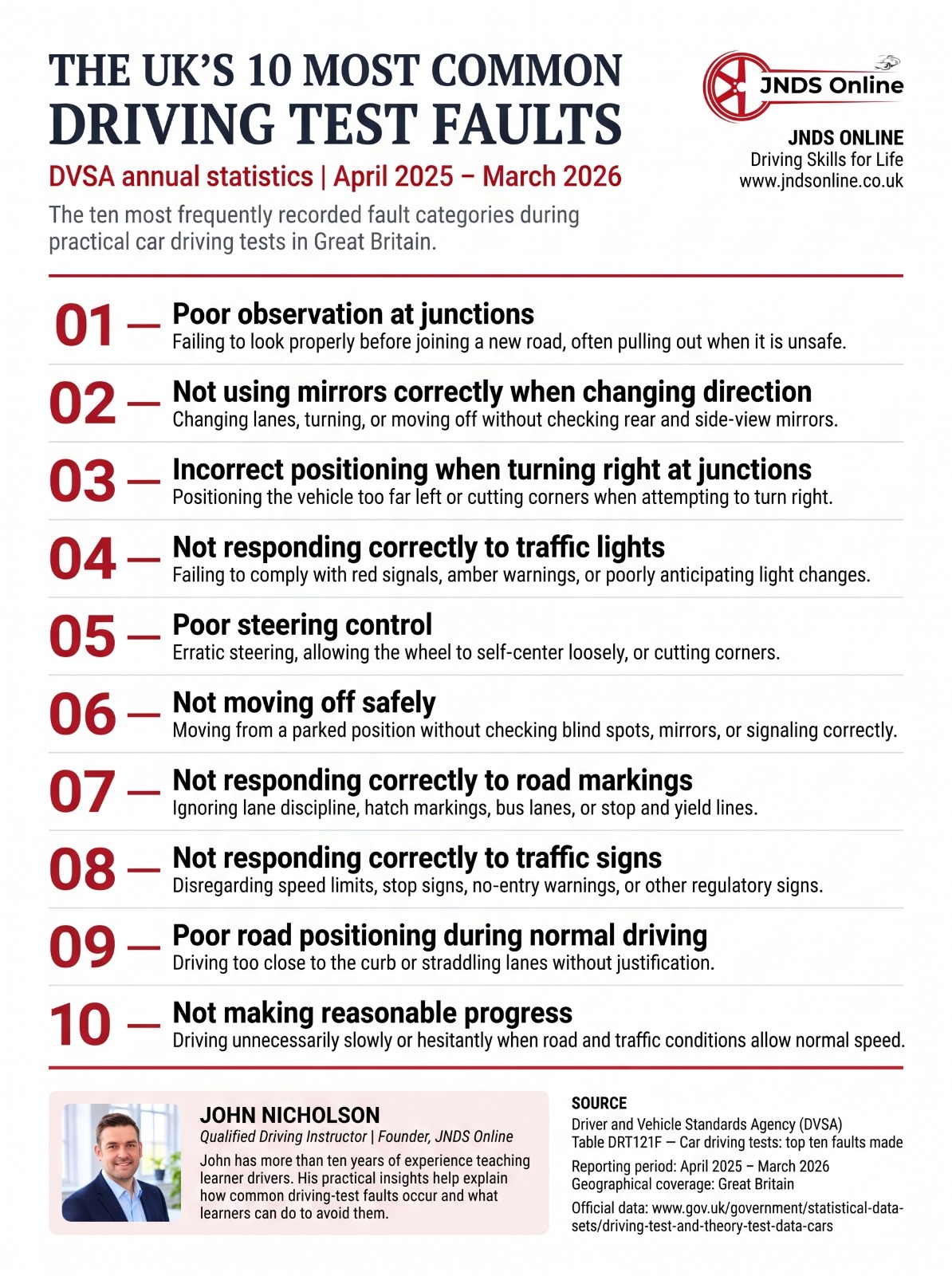
Top 10 reasons driving test fail UK
Published: July 15, 2026

Top 10 Reasons Driving Test Fail UK

Failing a practical driving test can be disappointing, but it is important to remember that many learners fail for the same common reasons. Most mistakes are not caused by a…

Failing a practical driving test can be disappointing, but it is important to remember that many learners fail for the same common reasons. Most mistakes are not caused by a lack of driving ability. Instead, they often happen because of nerves, missed observations or small errors that can be corrected with the right preparation.

Being a driving Instructor myself over the last decade serving Darlington in England as John Nicholson Driving School I have seen many of these top 10 fails come up on many occasions and mastered how to get my pupils to avoid falling into these situations

Understanding the most common driving test faults can help you focus your practice on the areas that matter most, not just not learning to not do them but as set out below what it is, why it happens and how knowing the dangers of making these mistakes, there is no better remedy than for a good reason why not to do it and that's why most my students pass first time.

By recognising these mistakes before your test, you can improve your confidence, develop safer driving habits and increase your chances of passing without nerves.

At JNDS Online, we help learner drivers build confidence through structured learning with, practical guidance and effective preparation for the practical driving test.

See below the top 10 fails in the Uk

Poor Observation at Junctions

Observation at junctions is the most common reason learners fail their driving test.

Many faults happen because drivers look too late, fail to notice approaching vehicles or misjudge the speed of oncoming traffic. It is also important to watch for cyclists, pedestrians and motorcyclists before moving out.

Developing a consistent observation routine helps you make safer decisions. Always check both directions carefully and only continue when you are confident it is safe to do so.

How my students have failed for this? 

For example I can give multiple examples with different students, I had one student who was waiting at a roundabout, it was extremely busy and he was just wanting to get out of there.

Remember that is the worse thing you can do, its so much harder to fail for hesitation that it is for going when it is not safe, In the words of one examiner, he explained to sarah that unless the examiner is sat there thinking why the hell are they not going then its not gonna be marked down as a fail. 

Another example is no looking both ways minimum twice both ways, I had 1 student who looked right when turning left and went to commit, its not enough, there was a traffic light turned red donn the road too a left therefore a build up of traffic. 

How do I avoid these faults?

SPEED!

Most people are in a rush in life, what we see from our family, freind's, what you have done as an international driver will not be classed as  test standard so slow down at a junction to a walking pace before a car length from a junction if its a gear 1 junction, look both ways before committing and look last the direction you intend to drive, and remember to check ahead if its a crossroads.

The examiner just wants to feel safe.

Use of Mirrors  when changing direction

Good mirror use demonstrates awareness of what is happening around your vehicle.

So on the DL25 marking sheet there is 3 mirror boxeds that can be marked

Mirrors when signalling

This is for example coming too a junction and you failing to to check mirror prior to see what's approaching from behind, a good example of one of my fails for this was my student was following the satnav and its instructing him to follow the roads for Barnard Castle which was a right turn 4th exit at the roundabout.

He started moving over and put the signal on and there was a car tailgating so because he didn't check his centre and right mirror he stopped the car from passing, if he checked that right mirror he could have signalled over to tell the car to back off, because 5the examiner had to grab the steering wheel this was marked as a fail.

How to avoid this?

Whenever your coming to a junction and needing to signal check your centre mirror followed by your directional mirror.

This way you can know your surroundings and know what or who you are signalling for. 

Mirrors when changing direction

A great example of this one is bus, bike and taxi lanes, you wouldn't cross a road blindfolded so know whats' coming down the road when ever your switching lanes, going around parked vehicles and using your steering wheel.

I had a student driving down Yarm road in the town centre and she only had two driver faults and failed her test for not checking her mirrors to the left when moving at the end of a buis lane, before you reach the end the last thing you want is to feel the impact of a bus, unfortunetly she failed but with good reason, do it multiple times and you will run out of luck eventually.

Mirrors when changing speed

Mirros when changing speed is when you are slowing down or speeding up, especially significantly. 

for example I had a student who had some traffic lights that went red and they were withing the point of no return so they stopped. 

They failed to check centre mirror and severely affected the braking of the car behind, if they checked mirror they would have seen how close the car was and adjusted the braking accordingly.

How  do I avoid this? 

Plan better, if i am coming too a set of traffic lights regulating traffic I am checking mirrors early, examiner sees this they then know if it changes your ready for the appropriate breaking. 

Examiners expect you to check your mirrors before changing direction, slowing down, turning or changing lanes. Missing these checks can result in driving faults because it suggests limited awareness of other road users, but remember it can more importantly lead too a crash

Not Moving Off Safely

Moving away safely is commonly marked because you didnt check or were late checking your blindspot.
Checking the blind spot should be the last thing you should do before moving off the car, and both blind spots behind you on all your manouvures for every shunt and don't forget both blind spots  on the emergency stop.
I had one lad years ago and he was doing a half check out hid door window, its not enough, that's where the blind spot starts but its not enough, make sure to check out the rear door window also, if you struggle to turn that far round use the steering wheel as a leverage but check it, if a car is pulling out of a road opposite you wont see it in the door mirror. 
This particular student failed for multiple faults in one box for moving off safely, remember 3 or more in one box and they can fail you, and remember if the circumstances are different like you affect the traffic, you can instantly fail for this, its in the top 10 for a reason. 
 
Moving away safely is area where learners often lose marks.

Before pulling away, check your mirrors, complete a blind spot check and make sure it is safe to join the traffic. During emergency stop exercises, the examiner will also expect you to move away safely once instructed, make sure to check both sides.

Taking a few extra seconds to complete proper observations is always better than rushing into traffic or into a person in a busy car park.

Incorrect Positioning turning right at Junctions

I see this a lot with international drivers, so if your on an international licence permit take note, we need to help keep traffic moving where we can. 

For that reason don't block traffic when turning right, sometimes we cant help it if the road is narrow but where there is a designated box, use it, even if only two wheels fit in and don't  forget too enter a yellow box junction if your exit road is clear.

i had a student fail for turning right at Blackwell and they didn't position next to the centre line while waiting then suddenly all the traffic was stopped on a  60mph road, if they had positioned a metre to the right this would have kept the traffic flowing and they would have passed their driving test. 

How do I avoid this fault?

Correct road positioning allows other drivers to understand your intentions and helps traffic flow safely.

Make sure you position the vehicle incorrectly when turning right or approaching busy junctions. This can create confusion for other road users and increase the risk of mistakes.

Practise choosing the correct lane early, maintain good lane discipline and position your vehicle smoothly as you approach each junction and read road markings and signs.


Poor Steering Control

Students are shocked with how many things can go wrong with steering, whilst its true you don't have to use the pull push method it is still best practice, however if steering is effective we don't nmeed to chaneg it.
there is a few things you may get marked for with steering and its not cause of how you hold it. 
Sam who learned with me years ago once failed his test for steering around a parked car but because he was closer than his hold back position he didn't steer enough round it and got too close resulting in him failing his driving test.
How do I avoid making a steering fault on test?

Smooth steering demonstrates confidence and good vehicle control.

Some learners grip the steering wheel too tightly or make sudden steering movements when under pressure. Others struggle to keep the vehicle centred within the lane.

Practising controlled steering helps maintain direction and creates a smoother driving experience for both you and your passengers.

Remember that calm steering often leads to calmer driving.

Responding to Traffic Lights

The one that surprises most. 
Response to traffic lights is a common one with loads of potential for areas and again one i see international drivers get wrong time after time which is why i heavily target this with my students, in fact upon writing this my last student to fail failed for this.
lovely drive, one driver fault and then the dreaded traffic light.
H was third car in the cue, followed the other cars through nicely and just as he went over the advanced stop line for bikes it turned red, he stopped. He failed with just the one driver fault and everyone was gutted, examiner, my student and of course myself. 
How do i avoid failing my driving test for this?

Traffic lights require careful observation and good judgement.

Approaching lights too quickly or making rushed decisions at amber signals can result in unnecessary faults. Examiners want to see that you respond safely rather than reacting suddenly.

Observe traffic ahead, anticipate changing signals and be prepared to stop safely whenever necessary. Planning ahead gives you more time to make sensible decisions.

Remember, if your passed your stop line on green, don't stop unless for an emergency vehicle, ask yourself on approach to a green light how long it has been on green and plan accordingly and if your turning right at traffic lights, when it goes red drive on being nobody has rushed through a red light, don't wait cause you will be blocking the traffic that has went green, and one more thing, if its congested, don't commit over the stop line when the light is on green if it means you block the junction as if it turns red and your still blocking the opening your toast. 


Independent Driving and Following Directions

Independent driving is an important part of the practical driving test and now forms a significant part of your overall assessment.

During your test, the examiner may ask you to follow:

  • Directions from a sat nav
  • Traffic signs
  • A combination of both

Under the latest DVSA guidance, the independent driving section can continue for the remainder of the practical driving test. The examiner will tell you whether to follow the sat nav, traffic signs or a combination of both, and they will set up the sat nav for you if it is being used.

If you take the wrong turning but do so safely, do not panic. You will not fail simply for going the wrong way. The examiner will give you new directions and continue the test. The assessment is based on your ability to drive safely, make good observations and respond correctly to changing road conditions.

Practising with both sat nav directions and road signs before your test will help you feel more confident during the independent driving section.

Responding to Road Markings

Road markings provide clear guidance about where and how you should drive.

During your test, you may encounter lane arrows, give way markings, box junctions and other road instructions. Ignoring these markings can lead to avoidable driving faults.

Pay attention to road markings well in advance so you have enough time to react smoothly without making sudden changes.

Planning ahead is one of the best ways to improve your driving performance.

Reverse Parking Mistakes

Reverse parking remains one of the manoeuvres that many learners find challenging.

Whether completing bay parking or parallel parking, success depends on careful observations, slow vehicle control and accurate positioning.

Do not focus only on the parking space. Continue checking around the vehicle throughout the manoeuvre to make sure it remains safe to continue.

Regular practice helps build confidence and improves consistency during the driving test.

How to Improve Your Chances of Passing

Passing your driving test is about developing safe driving habits rather than memorising routes.

Practise regularly in different road conditions and become comfortable driving independently using both road signs and sat nav directions. As the independent driving section can now continue for much of the practical driving test, building confidence without constant instruction is more important than ever.

Completing mock driving tests also helps you become familiar with the format of the practical test while reducing nerves.

Learn from mistakes instead of worrying about them. Every lesson provides an opportunity to improve your driving skills.

Stay calm throughout your test and remember that the examiner is assessing your ability to drive safely rather than expecting perfection.

Listening carefully to your driving instructor and acting on feedback will also help strengthen weaker areas before test day.

Conclusion

Most practical driving test failures happen because of common mistakes that can be improved through consistent practice and good preparation.

By focusing on observation, hazard awareness, vehicle control, road positioning and confidence, you can significantly improve your chances of passing your driving test first time.

At JNDS Online, we support learner drivers with structured resources designed to build confidence and develop safe driving habits. With the right preparation, regular practice and a positive mindset, you can approach your practical driving test feeling ready to succeed.

Frequently Asked Questions

What is the most common reason learners fail their driving test?

Poor observation at junctions remains one of the most common reasons learners receive serious driving faults during the practical driving test.

Can I pass my driving test with minor faults?

Yes. You can receive up to 15 driving faults and still pass, provided you do not receive any serious or dangerous faults.

Has the independent driving section changed?

Yes. Under the latest DVSA guidance, the independent driving section can continue for the remainder of the practical driving test. During this time, you may be asked to follow directions from a sat nav, traffic signs or a combination of both. The examiner will tell you which method to follow before you begin.

How can I improve my chances of passing first time?

Practise regularly, complete mock driving tests, improve your observations, become confident following both sat nav directions and road signs, stay calm and follow the guidance provided by your driving instructor.

Should I practise reverse parking before my driving test?

Yes. Bay parking and parallel parking require good vehicle control and careful observations. Regular practice helps improve confidence and accuracy.

Why are mirror checks so important?

Mirror checks help you stay aware of surrounding traffic before changing direction, slowing down, turning or moving away safely.

How can JNDS Online help me prepare for my driving test?

JNDS Online provides structured learning resources, practical guidance and preparation techniques that help learner drivers build confidence, improve driving skills and prepare effectively for their practical driving test.

ffFailing a practical driving test can be disappointing, but it is important to remember that many learners fail for the same common reasons. Most mistakes are not caused by a lack of driving ability. Instead, they often happen because of nerves, missed observations or small errors that can be corrected with the right preparation.

Being a driving Instructor myself over the last decade serving Darlington in England as John Nicholson Driving School I have seen many of these top 10 fails come up on many occasions and mastered how to get my pupils to avoid falling into these situations

Understanding the most common driving test faults can help you focus your practice on the areas that matter most, not just not learning to not do them but as set out below what it is, why it happens and how knowing the dangers of making these mistakes, there is no better remedy than for a good reason why not to do it and that's why most my students pass first time.

By recognising these mistakes before your test, you can improve your confidence, develop safer driving habits and increase your chances of passing without nerves.

At JNDS Online, we help learner drivers build confidence through structured learning with, practical guidance and effective preparation for the practical driving test.

See below the top 10 fails in the Uk

Poor Observation at Junctions

Observation at junctions is the most common reason learners fail their driving test.

Many faults happen because drivers look too late, fail to notice approaching vehicles or misjudge the speed of oncoming traffic. It is also important to watch for cyclists, pedestrians and motorcyclists before moving out.

Developing a consistent observation routine helps you make safer decisions. Always check both directions carefully and only continue when you are confident it is safe to do so.

How my students have failed for this? 

For example I can give multiple examples with different students, I had one student who was waiting at a roundabout, it was extremely busy and he was just wanting to get out of there.

Remember that is the worse thing you can do, its so much harder to fail for hesitation that it is for going when it is not safe, In the words of one examiner, he explained to sarah that unless the examiner is sat there thinking why the hell are they not going then its not gonna be marked down as a fail. 

Another example is no looking both ways minimum twice both ways, I had 1 student who looked right when turning left and went to commit, its not enough, there was a traffic light turned red donn the road too a left therefore a build up of traffic. 

How do I avoid these faults?

SPEED!

Most people are in a rush in life, what we see from our family, freind's, what you have done as an international driver will not be classed as  test standard so slow down at a junction to a walking pace before a car length from a junction if its a gear 1 junction, look both ways before committing and look last the direction you intend to drive, and remember to check ahead if its a crossroads.

The examiner just wants to feel safe.

Use of Mirrors  when changing direction

Good mirror use demonstrates awareness of what is happening around your vehicle.

So on the DL25 marking sheet there is 3 mirror boxeds that can be marked

Mirrors when signalling

This is for example coming too a junction and you failing to to check mirror prior to see what's approaching from behind, a good example of one of my fails for this was my student was following the satnav and its instructing him to follow the roads for Barnard Castle which was a right turn 4th exit at the roundabout.

He started moving over and put the signal on and there was a car tailgating so because he didn't check his centre and right mirror he stopped the car from passing, if he checked that right mirror he could have signalled over to tell the car to back off, because 5the examiner had to grab the steering wheel this was marked as a fail.

How to avoid this?

Whenever your coming to a junction and needing to signal check your centre mirror followed by your directional mirror.

This way you can know your surroundings and know what or who you are signalling for. 

Mirrors when changing direction

A great example of this one is bus, bike and taxi lanes, you wouldn't cross a road blindfolded so know whats' coming down the road when ever your switching lanes, going around parked vehicles and using your steering wheel.

I had a student driving down Yarm road in the town centre and she only had two driver faults and failed her test for not checking her mirrors to the left when moving at the end of a buis lane, before you reach the end the last thing you want is to feel the impact of a bus, unfortunetly she failed but with good reason, do it multiple times and you will run out of luck eventually.

Mirrors when changing speed

Mirros when changing speed is when you are slowing down or speeding up, especially significantly. 

for example I had a student who had some traffic lights that went red and they were withing the point of no return so they stopped. 

They failed to check centre mirror and severely affected the braking of the car behind, if they checked mirror they would have seen how close the car was and adjusted the braking accordingly.

How  do I avoid this? 

Plan better, if i am coming too a set of traffic lights regulating traffic I am checking mirrors early, examiner sees this they then know if it changes your ready for the appropriate breaking. 

Examiners expect you to check your mirrors before changing direction, slowing down, turning or changing lanes. Missing these checks can result in driving faults because it suggests limited awareness of other road users, but remember it can more importantly lead too a crash

Not Moving Off Safely

Moving away safely is commonly marked because you didnt check or were late checking your blindspot.
Checking the blind spot should be the last thing you should do before moving off the car, and both blind spots behind you on all your manouvures for every shunt and don't forget both blind spots  on the emergency stop.
I had one lad years ago and he was doing a half check out hid door window, its not enough, that's where the blind spot starts but its not enough, make sure to check out the rear door window also, if you struggle to turn that far round use the steering wheel as a leverage but check it, if a car is pulling out of a road opposite you wont see it in the door mirror. 
This particular student failed for multiple faults in one box for moving off safely, remember 3 or more in one box and they can fail you, and remember if the circumstances are different like you affect the traffic, you can instantly fail for this, its in the top 10 for a reason. 
 
Moving away safely is area where learners often lose marks.

Before pulling away, check your mirrors, complete a blind spot check and make sure it is safe to join the traffic. During emergency stop exercises, the examiner will also expect you to move away safely once instructed, make sure to check both sides.

Taking a few extra seconds to complete proper observations is always better than rushing into traffic or into a person in a busy car park.

Incorrect Positioning turning right at Junctions

I see this a lot with international drivers, so if your on an international licence permit take note, we need to help keep traffic moving where we can. 

For that reason don't block traffic when turning right, sometimes we cant help it if the road is narrow but where there is a designated box, use it, even if only two wheels fit in and don't  forget too enter a yellow box junction if your exit road is clear.

i had a student fail for turning right at Blackwell and they didn't position next to the centre line while waiting then suddenly all the traffic was stopped on a  60mph road, if they had positioned a metre to the right this would have kept the traffic flowing and they would have passed their driving test. 

How do I avoid this fault?

Correct road positioning allows other drivers to understand your intentions and helps traffic flow safely.

Make sure you position the vehicle incorrectly when turning right or approaching busy junctions. This can create confusion for other road users and increase the risk of mistakes.

Practise choosing the correct lane early, maintain good lane discipline and position your vehicle smoothly as you approach each junction and read road markings and signs.


Poor Steering Control

Students are shocked with how many things can go wrong with steering, whilst its true you don't have to use the pull push method it is still best practice, however if steering is effective we don't nmeed to chaneg it.
there is a few things you may get marked for with steering and its not cause of how you hold it. 
Sam who learned with me years ago once failed his test for steering around a parked car but because he was closer than his hold back position he didn't steer enough round it and got too close resulting in him failing his driving test.
How do I avoid making a steering fault on test?

Smooth steering demonstrates confidence and good vehicle control.

Some learners grip the steering wheel too tightly or make sudden steering movements when under pressure. Others struggle to keep the vehicle centred within the lane.

Practising controlled steering helps maintain direction and creates a smoother driving experience for both you and your passengers.

Remember that calm steering often leads to calmer driving.

Responding to Traffic Lights

The one that surprises most. 
Response to traffic lights is a common one with loads of potential for areas and again one i see international drivers get wrong time after time which is why i heavily target this with my students, in fact upon writing this my last student to fail failed for this.
lovely drive, one driver fault and then the dreaded traffic light.
H was third car in the cue, followed the other cars through nicely and just as he went over the advanced stop line for bikes it turned red, he stopped. He failed with just the one driver fault and everyone was gutted, examiner, my student and of course myself. 
How do i avoid failing my driving test for this?

Traffic lights require careful observation and good judgement.

Approaching lights too quickly or making rushed decisions at amber signals can result in unnecessary faults. Examiners want to see that you respond safely rather than reacting suddenly.

Observe traffic ahead, anticipate changing signals and be prepared to stop safely whenever necessary. Planning ahead gives you more time to make sensible decisions.

Remember, if your passed your stop line on green, don't stop unless for an emergency vehicle, ask yourself on approach to a green light how long it has been on green and plan accordingly and if your turning right at traffic lights, when it goes red drive on being nobody has rushed through a red light, don't wait cause you will be blocking the traffic that has went green, and one more thing, if its congested, don't commit over the stop line when the light is on green if it means you block the junction as if it turns red and your still blocking the opening your toast. 

Independent Driving and Following Directions

Independent driving is an important part of the practical driving test and now forms a significant part of your overall assessment.

During your test, the examiner may ask you to follow:

  • Directions from a sat nav
  • Traffic signs
  • A combination of both

Under the latest DVSA guidance, the independent driving section can continue for the remainder of the practical driving test. The examiner will tell you whether to follow the sat nav, traffic signs or a combination of both, and they will set up the sat nav for you if it is being used.

If you take the wrong turning but do so safely, do not panic. You will not fail simply for going the wrong way. The examiner will give you new directions and continue the test. The assessment is based on your ability to drive safely, make good observations and respond correctly to changing road conditions.

Practising with both sat nav directions and road signs before your test will help you feel more confident during the independent driving section.

Poor Road Positioning

Maintaining the correct road position is an important part of safe driving.

Learners sometimes drive too close to parked vehicles, drift between lanes or position themselves incorrectly on wider roads.

Good road positioning creates safe space around your vehicle and makes your intentions clearer to other road users.

Always stay aware of your surroundings and adjust your position whenever road conditions change.

How do i avoid failing my driving test for this?

Road markings provide clear guidance about where and how you should drive.

During your test, you may encounter lane arrows, give way markings, box junctions and other road instructions. Ignoring these markings can lead to avoidable driving faults.

Pay attention to road markings well in advance so you have enough time to react smoothly without making sudden changes.

Planning ahead is one of the best ways to improve your driving performance.

Reverse Parking Mistakes

Reverse parking remains one of the manoeuvres that many learners find challenging.

Whether completing bay parking or parallel parking, success depends on careful observations, slow vehicle control and accurate positioning.

Do not focus only on the parking space. Continue checking around the vehicle throughout the manoeuvre to make sure it remains safe to continue.

Regular practice helps build confidence and improves consistency during the driving test.

How to Improve Your Chances of Passing

Passing your driving test is about developing safe driving habits rather than memorising routes.

Practise regularly in different road conditions and become comfortable driving independently using both road signs and sat nav directions. As the independent driving section can now continue for much of the practical driving test, building confidence without constant instruction is more important than ever.

Completing mock driving tests also helps you become familiar with the format of the practical test while reducing nerves.

Learn from mistakes instead of worrying about them. Every lesson provides an opportunity to improve your driving skills.

Stay calm throughout your test and remember that the examiner is assessing your ability to drive safely rather than expecting perfection.

Listening carefully to your driving instructor and acting on feedback will also help strengthen weaker areas before test day.

Conclusion

Most practical driving test failures happen because of common mistakes that can be improved through consistent practice and good preparation.

By focusing on observation, hazard awareness, vehicle control, road positioning and confidence, you can significantly improve your chances of passing your driving test first time.

At JNDS Online, we support learner drivers with structured resources designed to build confidence and develop safe driving habits. With the right preparation, regular practice and a positive mindset, you can approach your practical driving test feeling ready to succeed.

Frequently Asked Questions

What is the most common reason learners fail their driving test?

Poor observation at junctions remains one of the most common reasons learners receive serious driving faults during the practical driving test.

Can I pass my driving test with minor faults?

Yes. You can receive up to 15 driving faults and still pass, provided you do not receive any serious or dangerous faults.

Has the independent driving section changed?

Yes. Under the latest DVSA guidance, the independent driving section can continue for the remainder of the practical driving test. During this time, you may be asked to follow directions from a sat nav, traffic signs or a combination of both. The examiner will tell you which method to follow before you begin.

How can I improve my chances of passing first time?

Practise regularly, complete mock driving tests, improve your observations, become confident following both sat nav directions and road signs, stay calm and follow the guidance provided by your driving instructor.

Should I practise reverse parking before my driving test?

Yes. Bay parking and parallel parking require good vehicle control and careful observations. Regular practice helps improve confidence and accuracy.

Why are mirror checks so important?

Mirror checks help you stay aware of surrounding traffic before changing direction, slowing down, turning or moving away safely.

How can JNDS Online help me prepare for my driving test?

JNDS Online provides structured learning resources, practical guidance and preparation techniques that help learner drivers build confidence, improve driving skills and prepare effectively for their practical driving test.

ffFailing a practical driving test can be disappointing, but it is important to remember that many learners fail for the same common reasons. Most mistakes are not caused by a lack of driving ability. Instead, they often happen because of nerves, missed observations or small errors that can be corrected with the right preparation.

Being a driving Instructor myself over the last decade serving Darlington in England as John Nicholson Driving School I have seen many of these top 10 fails come up on many occasions and mastered how to get my pupils to avoid falling into these situations

Understanding the most common driving test faults can help you focus your practice on the areas that matter most, not just not learning to not do them but as set out below what it is, why it happens and how knowing the dangers of making these mistakes, there is no better remedy than for a good reason why not to do it and that's why most my students pass first time.

By recognising these mistakes before your test, you can improve your confidence, develop safer driving habits and increase your chances of passing without nerves.

At JNDS Online, we help learner drivers build confidence through structured learning with, practical guidance and effective preparation for the practical driving test.

See below the top 10 fails in the Uk

Poor Observation at Junctions

Observation at junctions is the most common reason learners fail their driving test.

Many faults happen because drivers look too late, fail to notice approaching vehicles or misjudge the speed of oncoming traffic. It is also important to watch for cyclists, pedestrians and motorcyclists before moving out.

Developing a consistent observation routine helps you make safer decisions. Always check both directions carefully and only continue when you are confident it is safe to do so.

How my students have failed for this? 

For example I can give multiple examples with different students, I had one student who was waiting at a roundabout, it was extremely busy and he was just wanting to get out of there.

Remember that is the worse thing you can do, its so much harder to fail for hesitation that it is for going when it is not safe, In the words of one examiner, he explained to sarah that unless the examiner is sat there thinking why the hell are they not going then its not gonna be marked down as a fail. 

Another example is no looking both ways minimum twice both ways, I had 1 student who looked right when turning left and went to commit, its not enough, there was a traffic light turned red donn the road too a left therefore a build up of traffic. 

How do I avoid these faults?

SPEED!

Most people are in a rush in life, what we see from our family, freind's, what you have done as an international driver will not be classed as  test standard so slow down at a junction to a walking pace before a car length from a junction if its a gear 1 junction, look both ways before committing and look last the direction you intend to drive, and remember to check ahead if its a crossroads.

The examiner just wants to feel safe.

Use of Mirrors  when changing direction

Good mirror use demonstrates awareness of what is happening around your vehicle.

So on the DL25 marking sheet there is 3 mirror boxeds that can be marked

Mirrors when signalling

This is for example coming too a junction and you failing to to check mirror prior to see what's approaching from behind, a good example of one of my fails for this was my student was following the satnav and its instructing him to follow the roads for Barnard Castle which was a right turn 4th exit at the roundabout.

He started moving over and put the signal on and there was a car tailgating so because he didn't check his centre and right mirror he stopped the car from passing, if he checked that right mirror he could have signalled over to tell the car to back off, because 5the examiner had to grab the steering wheel this was marked as a fail.

How to avoid this?

Whenever your coming to a junction and needing to signal check your centre mirror followed by your directional mirror.

This way you can know your surroundings and know what or who you are signalling for. 

Mirrors when changing direction

A great example of this one is bus, bike and taxi lanes, you wouldn't cross a road blindfolded so know whats' coming down the road when ever your switching lanes, going around parked vehicles and using your steering wheel.

I had a student driving down Yarm road in the town centre and she only had two driver faults and failed her test for not checking her mirrors to the left when moving at the end of a buis lane, before you reach the end the last thing you want is to feel the impact of a bus, unfortunetly she failed but with good reason, do it multiple times and you will run out of luck eventually.

Mirrors when changing speed

Mirros when changing speed is when you are slowing down or speeding up, especially significantly. 

for example I had a student who had some traffic lights that went red and they were withing the point of no return so they stopped. 

They failed to check centre mirror and severely affected the braking of the car behind, if they checked mirror they would have seen how close the car was and adjusted the braking accordingly.

How  do I avoid this? 

Plan better, if i am coming too a set of traffic lights regulating traffic I am checking mirrors early, examiner sees this they then know if it changes your ready for the appropriate breaking. 

Examiners expect you to check your mirrors before changing direction, slowing down, turning or changing lanes. Missing these checks can result in driving faults because it suggests limited awareness of other road users, but remember it can more importantly lead too a crash

Not Moving Off Safely

Moving away safely is commonly marked because you didnt check or were late checking your blindspot.
Checking the blind spot should be the last thing you should do before moving off the car, and both blind spots behind you on all your manouvures for every shunt and don't forget both blind spots  on the emergency stop.
I had one lad years ago and he was doing a half check out hid door window, its not enough, that's where the blind spot starts but its not enough, make sure to check out the rear door window also, if you struggle to turn that far round use the steering wheel as a leverage but check it, if a car is pulling out of a road opposite you wont see it in the door mirror. 
This particular student failed for multiple faults in one box for moving off safely, remember 3 or more in one box and they can fail you, and remember if the circumstances are different like you affect the traffic, you can instantly fail for this, its in the top 10 for a reason. 
 
Moving away safely is area where learners often lose marks.

Before pulling away, check your mirrors, complete a blind spot check and make sure it is safe to join the traffic. During emergency stop exercises, the examiner will also expect you to move away safely once instructed, make sure to check both sides.

Taking a few extra seconds to complete proper observations is always better than rushing into traffic or into a person in a busy car park.

Incorrect Positioning turning right at Junctions

I see this a lot with international drivers, so if your on an international licence permit take note, we need to help keep traffic moving where we can. 

For that reason don't block traffic when turning right, sometimes we cant help it if the road is narrow but where there is a designated box, use it, even if only two wheels fit in and don't  forget too enter a yellow box junction if your exit road is clear.

i had a student fail for turning right at Blackwell and they didn't position next to the centre line while waiting then suddenly all the traffic was stopped on a  60mph road, if they had positioned a metre to the right this would have kept the traffic flowing and they would have passed their driving test. 

Correct road positioning allows other drivers to understand your intentions and helps traffic flow safely.

Many learners position the vehicle incorrectly when turning right or approaching busy junctions. This can create confusion for other road users and increase the risk of mistakes.

Practise choosing the correct lane early, maintain good lane discipline and position your vehicle smoothly as you approach each junction.

Poor Steering Control

Smooth steering demonstrates confidence and good vehicle control.

Some learners grip the steering wheel too tightly or make sudden steering movements when under pressure. Others struggle to keep the vehicle centred within the lane.

Practising controlled steering helps maintain direction and creates a smoother driving experience for both you and your passengers.

Remember that calm steering often leads to calmer driving.

Responding to Traffic Lights

Traffic lights require careful observation and good judgement.

Approaching lights too quickly or making rushed decisions at amber signals can result in unnecessary faults. Examiners want to see that you respond safely rather than reacting suddenly.

Observe traffic ahead, anticipate changing signals and be prepared to stop safely whenever necessary. Planning ahead gives you more time to make sensible decisions.

Independent Driving and Following Directions

Independent driving is an important part of the practical driving test and now forms a significant part of your overall assessment.

During your test, the examiner may ask you to follow:

  • Directions from a sat nav
  • Traffic signs
  • A combination of both

Under the latest DVSA guidance, the independent driving section can continue for the remainder of the practical driving test. The examiner will tell you whether to follow the sat nav, traffic signs or a combination of both, and they will set up the sat nav for you if it is being used.

If you take the wrong turning but do so safely, do not panic. You will not fail simply for going the wrong way. The examiner will give you new directions and continue the test. The assessment is based on your ability to drive safely, make good observations and respond correctly to changing road conditions.

Practising with both sat nav directions and road signs before your test will help you feel more confident during the independent driving section.

Poor Road Positioning

Maintaining the correct road position is an important part of safe driving.

Learners sometimes drive too close to parked vehicles, drift between lanes or position themselves incorrectly on wider roads.

Good road positioning creates safe space around your vehicle and makes your intentions clearer to other road users.

Always stay aware of your surroundings and adjust your position whenever road conditions change.

Responding to Road Markings

Road markings provide clear guidance about where and how you should drive.

During your test, you may encounter lane arrows, give way markings, box junctions and other road instructions. Ignoring these markings can lead to avoidable driving faults.

Pay attention to road markings well in advance so you have enough time to react smoothly without making sudden changes.

Planning ahead is one of the best ways to improve your driving performance.

Reverse Parking Mistakes

Reverse parking remains one of the manoeuvres that many learners find challenging.

Whether completing bay parking or parallel parking, success depends on careful observations, slow vehicle control and accurate positioning.

Do not focus only on the parking space. Continue checking around the vehicle throughout the manoeuvre to make sure it remains safe to continue.

Regular practice helps build confidence and improves consistency during the driving test.

How to Improve Your Chances of Passing

Passing your driving test is about developing safe driving habits rather than memorising routes.

Practise regularly in different road conditions and become comfortable driving independently using both road signs and sat nav directions. As the independent driving section can now continue for much of the practical driving test, building confidence without constant instruction is more important than ever.

Completing mock driving tests also helps you become familiar with the format of the practical test while reducing nerves.

Learn from mistakes instead of worrying about them. Every lesson provides an opportunity to improve your driving skills.

Stay calm throughout your test and remember that the examiner is assessing your ability to drive safely rather than expecting perfection.

Listening carefully to your driving instructor and acting on feedback will also help strengthen weaker areas before test day.

Conclusion

Most practical driving test failures happen because of common mistakes that can be improved through consistent practice and good preparation.

By focusing on observation, hazard awareness, vehicle control, road positioning and confidence, you can significantly improve your chances of passing your driving test first time.

At JNDS Online, we support learner drivers with structured resources designed to build confidence and develop safe driving habits. With the right preparation, regular practice and a positive mindset, you can approach your practical driving test feeling ready to succeed.

Frequently Asked Questions

What is the most common reason learners fail their driving test?

Poor observation at junctions remains one of the most common reasons learners receive serious driving faults during the practical driving test.

Can I pass my driving test with minor faults?

Yes. You can receive up to 15 driving faults and still pass, provided you do not receive any serious or dangerous faults.

Has the independent driving section changed?

Yes. Under the latest DVSA guidance, the independent driving section can continue for the remainder of the practical driving test. During this time, you may be asked to follow directions from a sat nav, traffic signs or a combination of both. The examiner will tell you which method to follow before you begin.

How can I improve my chances of passing first time?

Practise regularly, complete mock driving tests, improve your observations, become confident following both sat nav directions and road signs, stay calm and follow the guidance provided by your driving instructor.

Should I practise reverse parking before my driving test?

Yes. Bay parking and parallel parking require good vehicle control and careful observations. Regular practice helps improve confidence and accuracy.

Why are mirror checks so important?

Mirror checks help you stay aware of surrounding traffic before changing direction, slowing down, turning or moving away safely.

How can JNDS Online help me prepare for my driving test?

JNDS Online provides structured learning resources, practical guidance and preparation techniques that help learner drivers build confidence, improve driving skills and prepare effectively for their practical driving test.

ffFailing a practical driving test can be disappointing, but it is important to remember that many learners fail for the same common reasons. Most mistakes are not caused by a lack of driving ability. Instead, they often happen because of nerves, missed observations or small errors that can be corrected with the right preparation.

Being a driving Instructor myself over the last decade serving Darlington in England as John Nicholson Driving School I have seen many of these top 10 fails come up on many occasions and mastered how to get my pupils to avoid falling into these situations

Understanding the most common driving test faults can help you focus your practice on the areas that matter most, not just not learning to not do them but as set out below what it is, why it happens and how knowing the dangers of making these mistakes, there is no better remedy than for a good reason why not to do it and that's why most my students pass first time.

By recognising these mistakes before your test, you can improve your confidence, develop safer driving habits and increase your chances of passing without nerves.

At JNDS Online, we help learner drivers build confidence through structured learning with, practical guidance and effective preparation for the practical driving test.

See below the top 10 fails in the Uk

Poor Observation at Junctions

Observation at junctions is the most common reason learners fail their driving test.

Many faults happen because drivers look too late, fail to notice approaching vehicles or misjudge the speed of oncoming traffic. It is also important to watch for cyclists, pedestrians and motorcyclists before moving out.

Developing a consistent observation routine helps you make safer decisions. Always check both directions carefully and only continue when you are confident it is safe to do so.

How my students have failed for this? 

For example I can give multiple examples with different students, I had one student who was waiting at a roundabout, it was extremely busy and he was just wanting to get out of there.

Remember that is the worse thing you can do, its so much harder to fail for hesitation that it is for going when it is not safe, In the words of one examiner, he explained to sarah that unless the examiner is sat there thinking why the hell are they not going then its not gonna be marked down as a fail. 

Another example is no looking both ways minimum twice both ways, I had 1 student who looked right when turning left and went to commit, its not enough, there was a traffic light turned red donn the road too a left therefore a build up of traffic. 

How do I avoid these faults?

SPEED!

Most people are in a rush in life, what we see from our family, freind's, what you have done as an international driver will not be classed as  test standard so slow down at a junction to a walking pace before a car length from a junction if its a gear 1 junction, look both ways before committing and look last the direction you intend to drive, and remember to check ahead if its a crossroads.

The examiner just wants to feel safe.

Use of Mirrors  when changing direction

Good mirror use demonstrates awareness of what is happening around your vehicle.

So on the DL25 marking sheet there is 3 mirror boxeds that can be marked

Mirrors when signalling

This is for example coming too a junction and you failing to to check mirror prior to see what's approaching from behind, a good example of one of my fails for this was my student was following the satnav and its instructing him to follow the roads for Barnard Castle which was a right turn 4th exit at the roundabout.

He started moving over and put the signal on and there was a car tailgating so because he didn't check his centre and right mirror he stopped the car from passing, if he checked that right mirror he could have signalled over to tell the car to back off, because 5the examiner had to grab the steering wheel this was marked as a fail.

How to avoid this?

Whenever your coming to a junction and needing to signal check your centre mirror followed by your directional mirror.

This way you can know your surroundings and know what or who you are signalling for. 

Mirrors when changing direction

A great example of this one is bus, bike and taxi lanes, you wouldn't cross a road blindfolded so know whats' coming down the road when ever your switching lanes, going around parked vehicles and using your steering wheel.

I had a student driving down Yarm road in the town centre and she only had two driver faults and failed her test for not checking her mirrors to the left when moving at the end of a buis lane, before you reach the end the last thing you want is to feel the impact of a bus, unfortunetly she failed but with good reason, do it multiple times and you will run out of luck eventually.

Mirrors when changing speed

Mirros when changing speed is when you are slowing down or speeding up, especially significantly. 

for example I had a student who had some traffic lights that went red and they were withing the point of no return so they stopped. 

They failed to check centre mirror and severely affected the braking of the car behind, if they checked mirror they would have seen how close the car was and adjusted the braking accordingly.

How  do I avoid this? 

Plan better, if i am coming too a set of traffic lights regulating traffic I am checking mirrors early, examiner sees this they then know if it changes your ready for the appropriate breaking. 

Examiners expect you to check your mirrors before changing direction, slowing down, turning or changing lanes. Missing these checks can result in driving faults because it suggests limited awareness of other road users, but remember it can more importantly lead too a crash

Not Moving Off Safely

Moving away safely is commonly marked because you didnt check or were late checking your blindspot.
Checking the blind spot should be the last thing you should do before moving off the car, and both blind spots behind you on all your manouvures for every shunt and don't forget both blind spots  on the emergency stop.
I had one lad years ago and he was doing a half check out hid door window, its not enough, that's where the blind spot starts but its not enough, make sure to check out the rear door window also, if you struggle to turn that far round use the steering wheel as a leverage but check it, if a car is pulling out of a road opposite you wont see it in the door mirror. 
This particular student failed for multiple faults in one box for moving off safely, remember 3 or more in one box and they can fail you, and remember if the circumstances are different like you affect the traffic, you can instantly fail for this, its in the top 10 for a reason. 
 
Moving away safely is area where learners often lose marks.

Before pulling away, check your mirrors, complete a blind spot check and make sure it is safe to join the traffic. During emergency stop exercises, the examiner will also expect you to move away safely once instructed, make sure to check both sides.

Taking a few extra seconds to complete proper observations is always better than rushing into traffic or into a person in a busy car park.

Incorrect Positioning turning right at Junctions

I see this a lot with international drivers, so if your on an international licence permit take note, we need to help keep traffic moving where we can. 

For that reason don't block traffic when turning right, sometimes we cant help it if the road is narrow but where there is a designated box, use it, even if only two wheels fit in and don't  forget too enter a yellow box junction if your exit road is clear.

i had a student fail for turning right at Blackwell and they didn't position next to the centre line while waiting then suddenly all the traffic was stopped on a  60mph road, if they had positioned a metre to the right this would have kept the traffic flowing and they would have passed their driving test. 

Correct road positioning allows other drivers to understand your intentions and helps traffic flow safely.

Many learners position the vehicle incorrectly when turning right or approaching busy junctions. This can create confusion for other road users and increase the risk of mistakes.

Practise choosing the correct lane early, maintain good lane discipline and position your vehicle smoothly as you approach each junction.

Poor Steering Control

Smooth steering demonstrates confidence and good vehicle control.

Some learners grip the steering wheel too tightly or make sudden steering movements when under pressure. Others struggle to keep the vehicle centred within the lane.

Practising controlled steering helps maintain direction and creates a smoother driving experience for both you and your passengers.

Remember that calm steering often leads to calmer driving.

Responding to Traffic Lights

Traffic lights require careful observation and good judgement.

Approaching lights too quickly or making rushed decisions at amber signals can result in unnecessary faults. Examiners want to see that you respond safely rather than reacting suddenly.

Observe traffic ahead, anticipate changing signals and be prepared to stop safely whenever necessary. Planning ahead gives you more time to make sensible decisions.

Independent Driving and Following Directions

Independent driving is an important part of the practical driving test and now forms a significant part of your overall assessment.

During your test, the examiner may ask you to follow:

  • Directions from a sat nav
  • Traffic signs
  • A combination of both

Under the latest DVSA guidance, the independent driving section can continue for the remainder of the practical driving test. The examiner will tell you whether to follow the sat nav, traffic signs or a combination of both, and they will set up the sat nav for you if it is being used.

If you take the wrong turning but do so safely, do not panic. You will not fail simply for going the wrong way. The examiner will give you new directions and continue the test. The assessment is based on your ability to drive safely, make good observations and respond correctly to changing road conditions.

Practising with both sat nav directions and road signs before your test will help you feel more confident during the independent driving section.

Poor Road Positioning

Maintaining the correct road position is an important part of safe driving.

Learners sometimes drive too close to parked vehicles, drift between lanes or position themselves incorrectly on wider roads.

Good road positioning creates safe space around your vehicle and makes your intentions clearer to other road users.

Always stay aware of your surroundings and adjust your position whenever road conditions change.

Responding to Road Markings

Road markings provide clear guidance about where and how you should drive.

During your test, you may encounter lane arrows, give way markings, box junctions and other road instructions. Ignoring these markings can lead to avoidable driving faults.

Pay attention to road markings well in advance so you have enough time to react smoothly without making sudden changes.

Planning ahead is one of the best ways to improve your driving performance.

Reverse Parking Mistakes

Reverse parking remains one of the manoeuvres that many learners find challenging.

Whether completing bay parking or parallel parking, success depends on careful observations, slow vehicle control and accurate positioning.

Do not focus only on the parking space. Continue checking around the vehicle throughout the manoeuvre to make sure it remains safe to continue.

Regular practice helps build confidence and improves consistency during the driving test.

How to Improve Your Chances of Passing

Passing your driving test is about developing safe driving habits rather than memorising routes.

Practise regularly in different road conditions and become comfortable driving independently using both road signs and sat nav directions. As the independent driving section can now continue for much of the practical driving test, building confidence without constant instruction is more important than ever.

Completing mock driving tests also helps you become familiar with the format of the practical test while reducing nerves.

Learn from mistakes instead of worrying about them. Every lesson provides an opportunity to improve your driving skills.

Stay calm throughout your test and remember that the examiner is assessing your ability to drive safely rather than expecting perfection.

Listening carefully to your driving instructor and acting on feedback will also help strengthen weaker areas before test day.

Conclusion

Most practical driving test failures happen because of common mistakes that can be improved through consistent practice and good preparation.

By focusing on observation, hazard awareness, vehicle control, road positioning and confidence, you can significantly improve your chances of passing your driving test first time.

At JNDS Online, we support learner drivers with structured resources designed to build confidence and develop safe driving habits. With the right preparation, regular practice and a positive mindset, you can approach your practical driving test feeling ready to succeed.

Frequently Asked Questions

What is the most common reason learners fail their driving test?

Poor observation at junctions remains one of the most common reasons learners receive serious driving faults during the practical driving test.

Can I pass my driving test with minor faults?

Yes. You can receive up to 15 driving faults and still pass, provided you do not receive any serious or dangerous faults.

Has the independent driving section changed?

Yes. Under the latest DVSA guidance, the independent driving section can continue for the remainder of the practical driving test. During this time, you may be asked to follow directions from a sat nav, traffic signs or a combination of both. The examiner will tell you which method to follow before you begin.

How can I improve my chances of passing first time?

Practise regularly, complete mock driving tests, improve your observations, become confident following both sat nav directions and road signs, stay calm and follow the guidance provided by your driving instructor.

Should I practise reverse parking before my driving test?

Yes. Bay parking and parallel parking require good vehicle control and careful observations. Regular practice helps improve confidence and accuracy.

Why are mirror checks so important?

Mirror checks help you stay aware of surrounding traffic before changing direction, slowing down, turning or moving away safely.

How can JNDS Online help me prepare for my driving test?

JNDS Online provides structured learning resources, practical guidance and preparation techniques that help learner drivers build confidence, improve driving skills and prepare effectively for their practical driving test.

SEAN

ffFailing a practical driving test can be disappointing, but it is important to remember that many learners fail for the same common reasons. Most mistakes are not caused by a lack of driving ability. Instead, they often happen because of nerves, missed observations or small errors that can be corrected with the right preparation.

Being a driving Instructor myself over the last decade serving Darlington in England as John Nicholson Driving School I have seen many of these top 10 fails come up on many occasions and mastered how to get my pupils to avoid falling into these situations

Understanding the most common driving test faults can help you focus your practice on the areas that matter most, not just not learning to not do them but as set out below what it is, why it happens and how knowing the dangers of making these mistakes, there is no better remedy than for a good reason why not to do it and that's why most my students pass first time.

By recognising these mistakes before your test, you can improve your confidence, develop safer driving habits and increase your chances of passing without nerves.

At JNDS Online, we help learner drivers build confidence through structured learning with, practical guidance and effective preparation for the practical driving test.

See below the top 10 fails in the Uk

Poor Observation at Junctions

Observation at junctions is the most common reason learners fail their driving test.

Many faults happen because drivers look too late, fail to notice approaching vehicles or misjudge the speed of oncoming traffic. It is also important to watch for cyclists, pedestrians and motorcyclists before moving out.

Developing a consistent observation routine helps you make safer decisions. Always check both directions carefully and only continue when you are confident it is safe to do so.

How my students have failed for this? 

For example I can give multiple examples with different students, I had one student who was waiting at a roundabout, it was extremely busy and he was just wanting to get out of there.

Remember that is the worse thing you can do, its so much harder to fail for hesitation that it is for going when it is not safe, In the words of one examiner, he explained to sarah that unless the examiner is sat there thinking why the hell are they not going then its not gonna be marked down as a fail. 

Another example is no looking both ways minimum twice both ways, I had 1 student who looked right when turning left and went to commit, its not enough, there was a traffic light turned red donn the road too a left therefore a build up of traffic. 

How do I avoid these faults?

SPEED!

Most people are in a rush in life, what we see from our family, freind's, what you have done as an international driver will not be classed as  test standard so slow down at a junction to a walking pace before a car length from a junction if its a gear 1 junction, look both ways before committing and look last the direction you intend to drive, and remember to check ahead if its a crossroads.

The examiner just wants to feel safe.

Johns tip

Don't rush out, that doesn't mean stop every time but get your speed right on a approach and while creeping forward lean forward in your seat, get the best view of the road and take a gap where you feel like you would walk across, on faster roads walk there and back. 

The examiner just wants to feel safe.

Use of Mirrors  when changing direction

Good mirror use demonstrates awareness of what is happening around your vehicle.

So on the DL25 marking sheet there is 3 mirror boxeds that can be marked

Mirrors when signalling

This is for example coming too a junction and you failing to to check mirror prior to see what's approaching from behind, a good example of one of my fails for this was my student was following the satnav and its instructing him to follow the roads for Barnard Castle which was a right turn 4th exit at the roundabout.

He started moving over and put the signal on and there was a car tailgating so because he didn't check his centre and right mirror he stopped the car from passing, if he checked that right mirror he could have signalled over to tell the car to back off, because 5the examiner had to grab the steering wheel this was marked as a fail.

How to avoid this?

Whenever your coming to a junction and needing to signal check your centre mirror followed by your directional mirror.

This way you can know your surroundings and know what or who you are signalling for. 

Mirrors when changing direction

A great example of this one is bus, bike and taxi lanes, you wouldn't cross a road blindfolded so know whats' coming down the road when ever your switching lanes, going around parked vehicles and using your steering wheel.

I had a student driving down Yarm road in the town centre and she only had two driver faults and failed her test for not checking her mirrors to the left when moving at the end of a buis lane, before you reach the end the last thing you want is to feel the impact of a bus, unfortunetly she failed but with good reason, do it multiple times and you will run out of luck eventually.

Mirrors when changing speed

Mirros when changing speed is when you are slowing down or speeding up, especially significantly. 

for example I had a student who had some traffic lights that went red and they were withing the point of no return so they stopped. 

They failed to check centre mirror and severely affected the braking of the car behind, if they checked mirror they would have seen how close the car was and adjusted the braking accordingly.

How  do I avoid this? 

Plan better, if i am coming too a set of traffic lights regulating traffic I am checking mirrors early, examiner sees this they then know if it changes your ready for the appropriate breaking. 

Examiners expect you to check your mirrors before changing direction, slowing down, turning or changing lanes. Missing these checks can result in driving faults because it suggests limited awareness of other road users, but remember it can more importantly lead too a crash

Johns tip

Don't check your mirrors as the myths says every few seconds, when every you speed up, slow down or use the steering wheel is the correct time to check the appropriate mirrors, if you time this correctly you have all the information you need to react safely.

Not Moving Off Safely

Moving away safely is commonly marked because you didnt check or were late checking your blindspot.
Checking the blind spot should be the last thing you should do before moving off the car, and both blind spots behind you on all your manouvures for every shunt and don't forget both blind spots  on the emergency stop.
I had one lad years ago and he was doing a half check out hid door window, its not enough, that's where the blind spot starts but its not enough, make sure to check out the rear door window also, if you struggle to turn that far round use the steering wheel as a leverage but check it, if a car is pulling out of a road opposite you wont see it in the door mirror. 
This particular student failed for multiple faults in one box for moving off safely, remember 3 or more in one box and they can fail you, and remember if the circumstances are different like you affect the traffic, you can instantly fail for this, its in the top 10 for a reason. 
 
Moving away safely is area where learners often lose marks.

Before pulling away, check your mirrors, complete a blind spot check and make sure it is safe to join the traffic. During emergency stop exercises, the examiner will also expect you to move away safely once instructed, make sure to check both sides.

Taking a few extra seconds to complete proper observations is always better than rushing into traffic or into a person in a busy car park.

Johns Tip

Don't just use right mirror and blind spot when setting off, use the centre mirror and keep looking there.

Remember the centre mirror gives a true image so its reliable for gauging the correct distance from cars moving towards you.

When you get a safe gap follow it up with a right mirror and immediate right blind spot. 

This will ensure you don't unintentaly slow traffic down as the right mirror is convexed glass and makes vehicles look further away.

Incorrect Positioning turning right at Junctions

I see this a lot with international drivers, so if your on an international licence permit take note, we need to help keep traffic moving where we can. 

For that reason don't block traffic when turning right, sometimes we cant help it if the road is narrow but where there is a designated box, use it, even if only two wheels fit in and don't  forget too enter a yellow box junction if your exit road is clear.

i had a student fail for turning right at Blackwell and they didn't position next to the centre line while waiting then suddenly all the traffic was stopped on a  60mph road, if they had positioned a metre to the right this would have kept the traffic flowing and they would have passed their driving test. 

How do I avoid this fault?

Correct road positioning allows other drivers to understand your intentions and helps traffic flow safely.

Make sure you position the vehicle incorrectly when turning right or approaching busy junctions. This can create confusion for other road users and increase the risk of mistakes.

Practise choosing the correct lane early, maintain good lane discipline and position your vehicle smoothly as you approach each junction and read road markings and signs.

Johns Tip

practice turning right at crossroads that are traffic light controlled.

this gets you familiar with various size junctions, comfort sitting waiting for a safe gap, and gets you consistently using the centre point of the new road as a good position any right turn. 

You can use the centre line of the new road, the yellow and blue keep left sign and the road markings as guides for a good position. 

Normally sitting with your car just before centre point is a consistent success


Poor Steering Control

Students are shocked with how many things can go wrong with steering, whilst its true you don't have to use the pull push method it is still best practice, however if steering is effective we don't nmeed to chaneg it.
there is a few things you may get marked for with steering and its not cause of how you hold it. 
Sam who learned with me years ago once failed his test for steering around a parked car but because he was closer than his hold back position he didn't steer enough round it and got too close resulting in him failing his driving test.
How do I avoid making a steering fault on test?

Smooth steering demonstrates confidence and good vehicle control.

Some learners grip the steering wheel too tightly or make sudden steering movements when under pressure. Others struggle to keep the vehicle centred within the lane.

Practising controlled steering helps maintain direction and creates a smoother driving experience for both you and your passengers.

Remember that calm steering often leads to calmer driving.

Johns tip

Try not to sit with your thumbs in the steering wheel, whilst this is not a fault once one arm relaxes it causes the car to drift causing position faults, the ideal thumb position is your thumbs places face down on the front holding point of the steering wheel.

This gives a nice balance when driving and prevents over gripping the steering wheel.

Responding to Traffic Lights

The one that surprises most. 
Response to traffic lights is a common one with loads of potential for areas and again one i see international drivers get wrong time after time which is why i heavily target this with my students, in fact upon writing this my last student to fail failed for this.
lovely drive, one driver fault and then the dreaded traffic light.
H was third car in the cue, followed the other cars through nicely and just as he went over the advanced stop line for bikes it turned red, he stopped. He failed with just the one driver fault and everyone was gutted, examiner, my student and of course myself. 
How do i avoid failing my driving test for this?

Traffic lights require careful observation and good judgement.

Approaching lights too quickly or making rushed decisions at amber signals can result in unnecessary faults. Examiners want to see that you respond safely rather than reacting suddenly.

Observe traffic ahead, anticipate changing signals and be prepared to stop safely whenever necessary. Planning ahead gives you more time to make sensible decisions.

Remember, if your passed your stop line on green, don't stop unless for an emergency vehicle, ask yourself on approach to a green light how long it has been on green and plan accordingly and if your turning right at traffic lights, when it goes red drive on being nobody has rushed through a red light, don't wait cause you will be blocking the traffic that has went green, and one more thing, if its congested, don't commit over the stop line when the light is on green if it means you block the junction as if it turns red and your still blocking the opening your toast. 

Johns tip

Scan for traffic lights, if you see someone stood on a crossing its going to change shortly, especially if its a puffing crossing.

Adjust speed accordingly and be ready to stop.

Not responding correctly to roadmarkings

Again, another in the top 10 that stems from poor planning and lack of understand of road markings.
When learning someone to drive from the first day we teach to avoid bonnet gazing, which means looking down directly in front of the car.
Always look as far down the road as we can see and scan back, left and right we can acknowledge signs, and road markings.
If we don't see them we cant respond.
My last  person to fail for this was driving towards the stadium back to the driving test centre and they didnt see the secondry sign after the roundabouts exits sign, the sign clearly states right and lane for all other routes and they stayed in the left hand lane while going straight. 
This resulted in a fail as all the traffic in the right hand lane was on a collision course with my student if the examiner did not take action.
How can I avoid this on my driving test?
There is so much more that can go wrong on this, not acknowledging hatched markings, lane choices, stop lines, give way markings, double white lines turn arrows, cycle lanes, bus lanes box junctions keep clear markings and pedestrian crossings, forgive me if i missed any, but the point is train yourself to not just see signs, but to respond to them, one if the biggest things i see is people knowing its there but not responding too it. 
 

How do I avoid this fault on my driving test?

Know your signs and road markings, there is a great book called know your signs which costs about £4. It is priceless, it gives you knowledge and thats why the theory test is so important. 
if you a driving towards a roundabout at 50mph and taking a minute to work out what a road marking means then therin lies the problem. 

Road markings provide clear guidance about where and how you should drive.

During your test, you may encounter lane arrows, give way markings, box junctions and other road instructions. Ignoring these, not knowing what they are or even seeing them but not responding to them markings can lead to avoidable driving faults.

Pay attention to road markings well in advance so you have enough time to react smoothly without making sudden changes.

Planning ahead is one of the best ways to improve your driving performance.

Johns tip
 
Cut and extra few miles an hour approaching junctions, if we ran towards a cliff edge we would slow the approach down so do the same when approaching a junction, that way you can respond to what the road is telling you. 

Not responding correctly to traffic signs


 As with response to road markings, this is the a common fault on driving tests.

The thing I see with students time and time again is either not seeing the sign or not responding to the sign or understanding it. 

I had a student fail many years ago for approaching a right turn where there was two junctions close together and the examiner had to take action as she went to turn right into a road with a no entry sign.

If she sees the sign and understands it she doesn't fail her driving test. 

How do I avoid failing for response to road signs?

Just like the response to markings, stop signs, one way streets, bus lanes, no left/right turns ahead only, keep left, mine roundabout signs, speed limits, and the list goes on, if you see it, understand it, you respond positively too it.

Practice revision, identifying, responding in good time and you will improve your driving tenfold.

John Tip

Look as far down the road as you can see, the earlier you see a sign the more seconds your have to work out and respond  too it which reduces driver overload.

Poor road positioning on the road  during normal driving

This is what i teach my students as their NRP (normal road postion)

When driving we should predominantly drive on the left hand side of the road. 

I few don't have a normal driving position w4e can confuse other road users, for example driving too far left people may think we are going to turn left, if we drive too far right, people may react thinking we may cross their path.

I once had a student who failed for driving too close to the kerb. When they got to the end of the road they were asked to turnleft, needless to say as they were so close they severely mounted the kerb which resulted in them failing. 

How do I avoid failing my driving test for this?

When driving in the UK we drive left side with an ideal position being 1 metre from the kerb. You can use a reference point for this to get your positioning correct.

This gives you space to turn left, space to turn right and doesn't confuse people where you are going. 

if your on a 1 way system you can drive centrally and remember on a 1 way system when turning right position to the right. 

Always filter left for example after a bus lane and plan your lanes well ahead reading the signs we already talked about in good time. 

Don't lane hog the right lane on a dual carriageway and don't straddle to the right on a  roundabout when entering.

If you approach a roundabout on the left lane, stick to the left lane, if you approach in the right lane stick to the right lane till your exit. This term is called (straight lining).

Johns tip

When focusing on your NRP remember to use the left hand kerb as your reference, not the centre line as when you use the centre line the wider the road the more the line will pull you out of your NRP.

Not driving at a safe and reasonable speed. 

This is a one where students need to find the balance.

You can fail your test for driving too fast and you can also fail your driving test for driving too slow.

I had one student fail who was a beautiful driver, really high standard and she drove so slow every where which I had never seen her do. 

upon her failing I asked her why she drove at this speeds, he mum the night before her test told her to take her time and she will pass. 

An examiner also explained to my student who failed for going to slow that it was a 30 zone, there is no reason to drive less that 30. 

This may seem harsh, but its correct, it was a big wide busy road and if you cant control your on 30 in  a 30 zone then you need more practice.

Understandable people fear the brake limit but if you are good at it you don't need to fears it. 

I am hot on this and the first thing I always explain on this lesson plan is if you don't like a car travelling up close behind (tailgating) then don't drive too slow, as that's what will happen, sometimes its us that create that situation.

How can I prevent failing my test for this?

Firstly know the speed limit of the road, use  street lights, buildings, and repeater signs for clues.

practice using the gas pedal where you can maintain a set speed for a set amount of seconds then you can be confident.

Never change how you drive for the test, going too slow will fail you your test, scan your signs as mentioned in the previous section then you can bring your speed down with engine braking in good time.

change your speed for sections of road that are tighter, less space less speed. 

Johns tip

Always look for speed limit signs at the end of the road your on and at the start of the road your entering.

This is where the terminal; signs are which is the starting point of a new speed limit, after that if its not a 30 zone you will normally get repeater signs that normally repeat every 10 -15 seconds.

If you know you speed limits you cant accidently break the speed limit and you have already practice comfortably going the speed limit.

Bonus content

How do I avoid failing my driving test on manoeuvres

Every student stresses about getting the manoeuvres wrong, and the reality is its a small fraction of the test which takes round 1 minute, the rest of the test is driving. 

There is two marks that can be ticked on the reverse park manoeuvres, 

Control and observations.

In other words control there car as needed (slow) and that will give you time to observe correctly and effectively. 

There are 4 manouvres

reverse bay park

reverse parrall park

Forwards into a bay and reversing out

Parking on the right and reversing back 2 car lengths

How do I avoid failing my driving test on the manouvres

Look behind you out the back window, look at both blind spots and stop and asses anything approaching, even if its just for a second, if the obstruction is affecting you longer don't move for longer, once its clear and not effecting you carry on.

use slow concise clutch control, I always teach 1mph maximum, we a re not in a rush and your not on a timer. 

the examiner just wants to see you get it right and you can use up to 3 shunts if its not correct first attempt.

Johns tip

after every shunt do not miss a blind spot check, before you move check every time. 

How to Improve Your Chances of Passing

Passing your driving test is about developing safe driving habits rather than memorising routes.

Practise regularly in different road conditions and become comfortable driving independently using both road signs and sat nav directions. As the independent driving section can now continue for much of the practical driving test, building confidence without constant instruction is more important than ever.

Completing mock driving tests also helps you become familiar with the format of the practical test while reducing nerves.

Learn from mistakes instead of worrying about them. Every lesson provides an opportunity to improve your driving skills.

Stay calm throughout your test and remember that the examiner is assessing your ability to drive safely rather than expecting perfection.

Listening carefully to your driving instructor and acting on feedback will also help strengthen weaker areas before test day.

Conclusion

Most practical driving test failures happen because of common mistakes that can be improved through consistent practice and good preparation.

Also most mistakes i can link to speed, whether that's speed of car, speed of hands or speed of feet.

Our bodies naturally under pressure speed up the mind and speed up how we react.

By focusing on observation, hazard awareness, vehicle control, road positioning and confidence, you can significantly improve your chances of passing your driving test first time.

At JNDS Online, we support learner drivers with structured resources designed to build confidence and develop safe driving habits. With the right preparation, regular practice and a positive mindset, you can approach your practical driving test feeling ready to succeed.

Frequently Asked Questions

What is the most common reason learners fail their driving test?

Poor observation at junctions remains one of the most common reasons learners receive serious driving faults during the practical driving test.

Can I pass my driving test with minor faults?

Yes. You can receive up to 15 driving faults and still pass, provided you do not receive any serious or dangerous faults.

Has the independent driving section changed?

Yes. Under the latest DVSA guidance, the independent driving section can continue for the remainder of the practical driving test. During this time, you may be asked to follow directions from a sat nav, traffic signs or a combination of both. The examiner will tell you which method to follow before you begin.

How can I improve my chances of passing first time?

Practise regularly, complete mock driving tests, improve your observations, become confident following both sat nav directions and road signs, stay calm and follow the guidance provided by your driving instructor.

Should I practise reverse parking before my driving test?

Yes. Bay parking and parallel parking require good vehicle control and careful observations. Regular practice helps improve confidence and accuracy.

Why are mirror checks so important?

Mirror checks help you stay aware of surrounding traffic before changing direction, slowing down, turning or moving away safely.

How can JNDS Online help me prepare for my driving test?

JNDS Online provides structured learning resources, practical guidance and preparation techniques that help learner drivers build confidence, improve driving skills and prepare effectively for their practical driving test.

JNDS Online Logo - Your Driving Test & Routing Partner
Enroll Now and Get Your Driving License Fast
Start Your Journey Today!